How to Read Tarot Cards
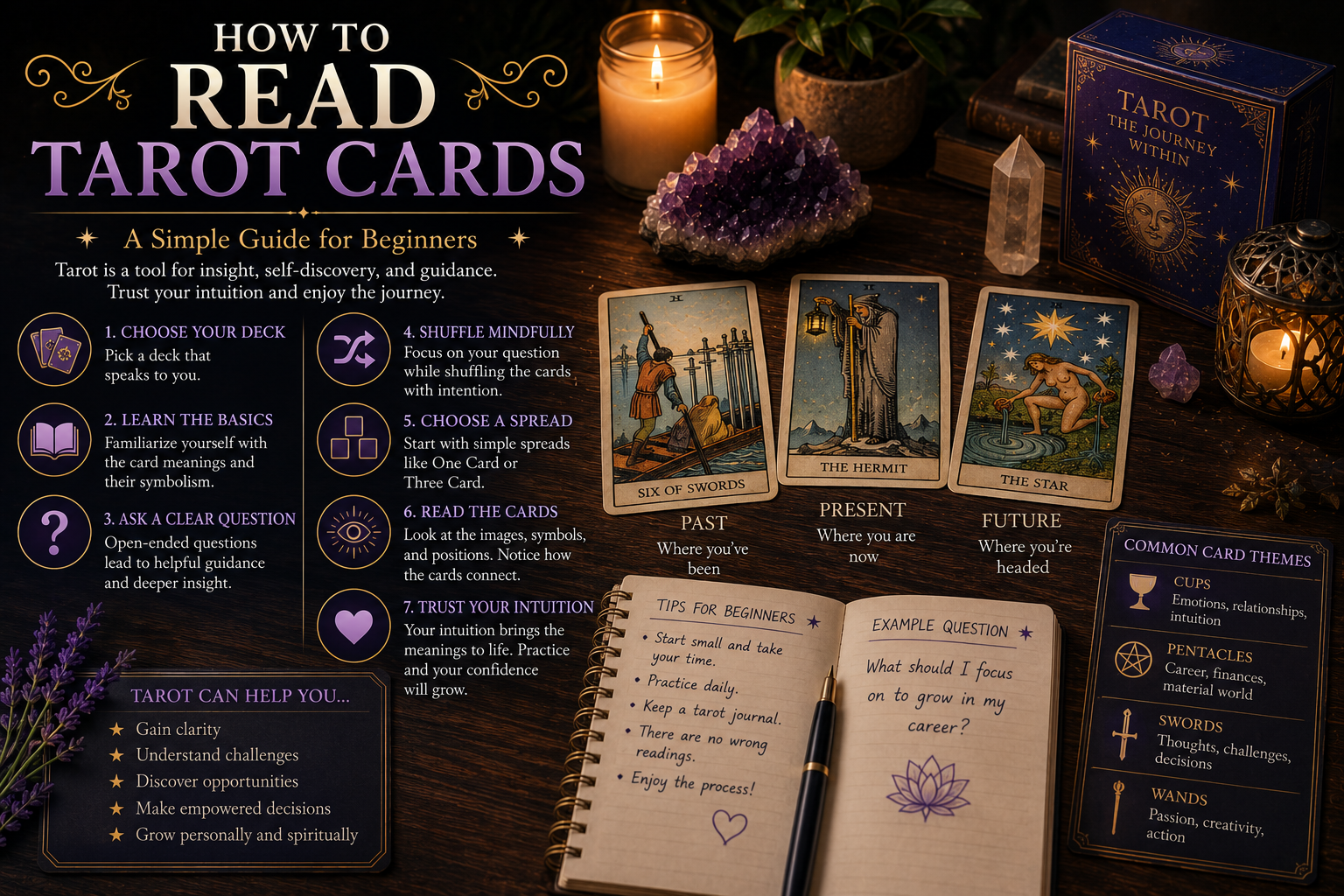
Discover the essential steps to reading tarot cards, from choosing your first deck to interpreting symbols and trusting your intuition for daily guidance.
How to Read Tarot Cards
Learning how to read tarot cards can be an exciting journey of self-discovery, intuition, and personal growth. Whether you're completely new to tarot or looking to improve your skills, understanding the basics will help you perform more meaningful and confident readings.
Tarot is not about memorizing every card overnight or predicting the future with certainty. Instead, it is a symbolic system that encourages reflection, helps you explore different perspectives, and supports thoughtful decision-making.
In this beginner-friendly guide, you'll learn the essential steps to start reading tarot cards with confidence.
What Are Tarot Cards?
A traditional tarot deck contains 78 cards, divided into two main groups.
Major Arcana (22 Cards)
The Major Arcana represents important life lessons, personal growth, and significant turning points.
Some well-known cards include:
The Fool
The Magician
The High Priestess
The Lovers
The Hermit
Death
The Star
The World
These cards often highlight major themes in a reading.
Minor Arcana (56 Cards)
The Minor Arcana focuses on everyday experiences and is divided into four suits:
Cups (emotions and relationships)
Pentacles (career and finances)
Swords (thoughts and challenges)
Wands (passion and creativity)
Each suit contains:
Ace through Ten
Page
Knight
Queen
King
Together, the Major and Minor Arcana create a complete picture of a situation.
✨ Try Your Free AI Tarot Reading
Discover what the cards reveal about your love life, career, and future.
Step 1 — Choose Your Tarot Deck
For beginners, it's often easiest to start with a traditional deck such as the Rider-Waite-Smith Tarot because its imagery is widely used in books and online guides.
Choose a deck whose artwork feels meaningful and comfortable to you. A strong personal connection can make learning more enjoyable.
Step 2 — Learn the Basic Meanings
You don't need to memorize all 78 cards immediately.
Start by learning:
The Fool
The Magician
The Lovers
The Hermit
The Star
Ace of Cups
Ace of Pentacles
Three of Cups
Ten of Cups
As you become familiar with these cards, gradually expand your knowledge.
Looking carefully at the artwork often reveals important symbolic clues.
Step 3 — Ask a Clear Question
Tarot works best when your question is open-ended.
Instead of asking:
Will I become rich?
Try asking:
What can I do to improve my finances?
What opportunity should I notice?
What should I focus on in my career?
Questions that encourage reflection usually create richer readings.
Step 4 — Shuffle the Cards
There is no single "correct" way to shuffle tarot cards.
Many readers simply:
Shuffle until it feels natural.
Focus on their question.
Relax and clear their mind.
Cut the deck if they wish.
Draw the cards.
The goal is simply to prepare yourself mentally for the reading.
Step 5 — Choose a Tarot Spread
Beginners should start with simple spreads.
One Card Reading
Perfect for:
Daily guidance
Quick insight
Reflection
Three Card Spread
One of the most popular layouts.
Common interpretations include:
Past – Present – Future
Situation – Challenge – Advice
Mind – Body – Spirit
As you gain confidence, you can explore larger spreads.
Step 6 — Read the Cards Together
Avoid interpreting every card separately.
Instead, look for connections.
Ask yourself:
What story do these cards tell?
Which symbols repeat?
Which emotions appear?
Are there several cards from the same suit?
What overall message stands out?
The relationships between the cards are often more meaningful than individual definitions.
Step 7 — Trust Your Intuition
Guidebooks are helpful, but your own observations matter too.
Pay attention to:
Colors
Facial expressions
Symbols
Body language
Your first impressions
Intuition develops naturally through regular practice.
Common Beginner Mistakes
Many new readers:
Try to memorize every meaning immediately.
Ask the same question repeatedly.
Expect exact predictions.
Ignore the artwork.
Become discouraged after difficult cards.
Remember that cards such as Death, Tower, or Devil usually represent transformation, change, or personal challenges—not literal events.
Practice Every Day
The fastest way to improve is consistent practice.
Try drawing one card each day and ask:
What can I learn today?
What energy surrounds me?
What should I focus on?
Write your interpretation in a journal and revisit it later to see how your understanding grows.
Can You Read Tarot for Yourself?
Absolutely.
Many people begin by reading for themselves before reading for others.
Self-readings can help you:
Reflect on emotions
Clarify decisions
Explore personal growth
Develop intuition
Just remember to stay open-minded and avoid interpreting the cards only in ways that confirm what you already hope to hear.
Final Thoughts on How to Read Tarot Cards
Learning how to read tarot cards is a journey rather than a destination.
Every reading helps you develop your understanding of the cards, strengthen your intuition, and explore life's questions with greater curiosity and awareness.
There are no perfect readers—only readers who continue to learn.
Take your time, practice regularly, trust your observations, and enjoy discovering the wisdom that tarot's rich symbolism has to offer.
Frequently Asked Questions
Is tarot difficult to learn?
Not at all. Anyone can learn tarot with regular practice; most beginners become comfortable with the basics by spending time with the cards consistently.
Do I need psychic abilities to read tarot?
No, tarot does not require psychic abilities. Successful readings come from understanding symbolism, asking thoughtful questions, and reflecting on the cards' imagery.
Should I memorize every tarot card meaning immediately?
No. It is better to start with major themes and gradually build your knowledge by looking at the artwork and the story the cards tell.
How often should I practice tarot?
Daily practice, such as drawing a single card each morning for reflection, is the best way to improve your confidence and deepen your understanding.
✨ Try Your Free AI Tarot Reading
Discover what the cards reveal about your love life, career, and future.
Helping users explore tarot, spirituality, love guidance, and AI-powered readings.