Tarot for Beginners
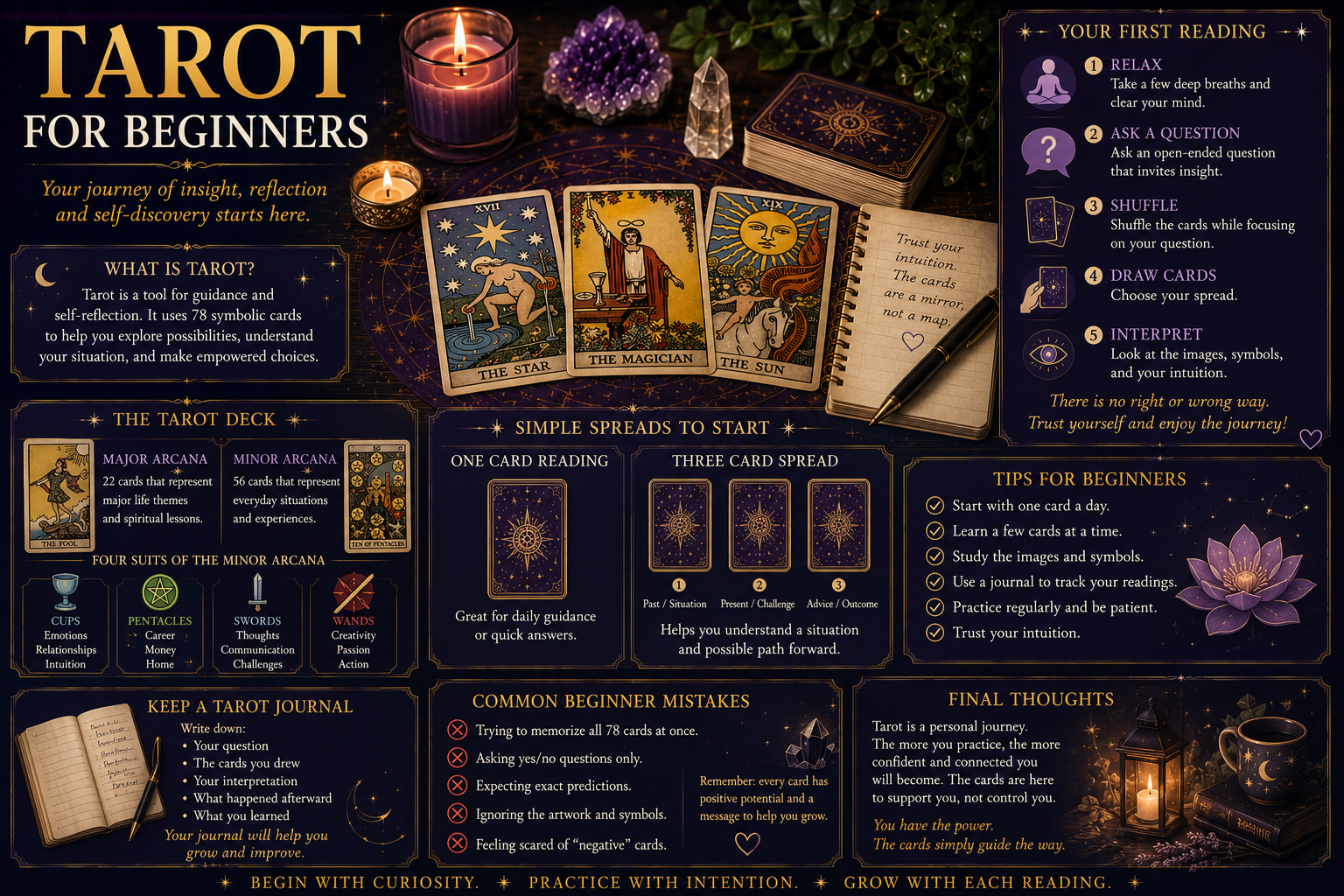
This comprehensive guide to tarot for beginners explores the Major and Minor Arcana, offering practical tips for choosing a deck and performing your first reading.
Tarot for Beginners
If you've ever been curious about tarot but weren't sure where to start, you're not alone. Tarot for Beginners is all about learning the basics, understanding the symbolism of the cards, and developing the confidence to perform simple, meaningful readings.
The good news is that you don't need special abilities or years of experience to begin reading tarot. Anyone can learn by studying the cards, practicing regularly, and approaching each reading with curiosity and an open mind.
This guide covers everything beginners need to know to start their tarot journey.
What Is Tarot?
Tarot is a deck of 78 illustrated cards that has been used for centuries as a tool for reflection, storytelling, and personal insight.
Each card contains symbolic imagery that can help you explore:
Love and relationships
Career and work
Personal growth
Life decisions
Emotional well-being
Spiritual reflection
Rather than predicting the future with certainty, tarot encourages you to explore possibilities and better understand your current situation.
✨ Try Your Free AI Tarot Reading
Discover what the cards reveal about your love life, career, and future.
Understanding the Tarot Deck
A traditional tarot deck is divided into two sections.
Major Arcana (22 Cards)
The Major Arcana represents major life lessons and important turning points.
Some well-known cards include:
The Fool
The Magician
The High Priestess
The Empress
The Lovers
The Hermit
Death
The Star
The World
These cards often represent significant themes or transformative experiences.
Minor Arcana (56 Cards)
The Minor Arcana focuses on everyday situations and is divided into four suits.
Cups
Associated with:
Emotions
Relationships
Intuition
Compassion
Pentacles
Associated with:
Career
Money
Home
Material life
Swords
Associated with:
Thoughts
Communication
Decisions
Challenges
Wands
Associated with:
Creativity
Passion
Motivation
Action
Each suit contains Ace through Ten, plus the Page, Knight, Queen, and King.
Choosing Your First Tarot Deck
Your first deck doesn't need to be expensive or rare.
Many beginners choose a Rider-Waite-Smith style deck because:
Most books use its symbolism.
Card meanings are easy to learn.
Countless online resources explain each card.
Most importantly, choose artwork that you enjoy looking at. A deck you connect with personally is often more enjoyable to learn.
Learn the Cards Gradually
Trying to memorize all 78 cards at once can feel overwhelming.
Instead:
Learn a few cards each day.
Study the artwork.
Notice recurring symbols.
Compare similar cards.
Keep a journal.
Over time, the meanings become much easier to remember.
Your First Tarot Reading
When you're ready, begin with a simple reading.
Step 1 — Relax
Take a few slow breaths.
Find a quiet place where you won't be interrupted.
Step 2 — Ask a Question
Open-ended questions usually create the most meaningful readings.
Examples include:
What should I focus on today?
What lesson am I learning?
What opportunity is approaching?
How can I improve this situation?
Step 3 — Shuffle the Cards
Shuffle in whatever way feels comfortable.
There is no "correct" technique.
The goal is simply to focus on your question while preparing the deck.
Step 4 — Draw Your Cards
Beginners often start with:
One Card Reading
Three Card Spread
Both are easy to learn and provide meaningful insight.
Step 5 — Study the Images
Before looking up meanings, ask yourself:
What emotions do I notice?
Which symbols stand out?
What story do the cards tell together?
Your own observations are an important part of learning tarot.
Keep a Tarot Journal
One of the fastest ways to improve is keeping a journal.
Write down:
Your question
The cards you drew
Your interpretation
What happened afterward
What you learned
Over time, you'll begin noticing patterns and developing greater confidence.
Common Beginner Mistakes
Everyone makes mistakes while learning.
Some of the most common include:
Trying to memorize every card immediately.
Asking the same question repeatedly.
Expecting exact predictions.
Ignoring the artwork.
Feeling discouraged by "negative" cards.
Remember that cards such as Death or The Tower often symbolize change and transformation rather than literal events.
Tips for Learning Faster
As you continue practicing:
Read one card every day.
Compare similar cards.
Study the symbols.
Practice with friends.
Reflect after each reading.
Stay curious rather than seeking certainty.
Learning tarot is a gradual process, and every reading builds experience.
Final Thoughts on Tarot for Beginners
Learning Tarot for Beginners is the beginning of a rewarding journey filled with curiosity, creativity, and self-discovery.
You don't need to know every card immediately or perform perfect readings from day one.
Take your time, enjoy the learning process, ask thoughtful questions, and allow each reading to deepen your understanding of the cards.
The more you practice, the more natural tarot becomes—and every shuffle, every card, and every reading becomes another opportunity to learn something new about yourself and the world around you.
Frequently Asked Questions
Is tarot difficult for beginners to learn?
Not at all. While mastering all 78 cards takes time, beginners can start performing simple one-card readings almost immediately by focusing on the imagery and basic themes.
What is the best tarot deck for a beginner?
The Rider-Waite-Smith deck is the most recommended choice because its symbolism is clear and it is the standard for most educational books and online resources.
Do I need to be psychic to read tarot?
No, psychic abilities are not required. Tarot is a tool based on symbolism, storytelling, and personal reflection that anyone can learn through study and practice.
✨ Try Your Free AI Tarot Reading
Discover what the cards reveal about your love life, career, and future.
Helping users explore tarot, spirituality, love guidance, and AI-powered readings.